


Share the handbook
BEFORE YOU START
Being busy is not the same as building a business
You can stay busy all day without moving your business forward. You explain products, have conversations and gather information. But how much of that leads to action? That is what this handbook is about. We will give your start a clear structure and focus on the things you can learn and do yourself.
The Success Code starts with the story you tell yourself about this business. What do you see in Zinzino? What do you talk about? What do you believe you can do? Your answers shape how you approach people and which opportunities you notice in the first place.
I will take you from your own mindset to the practical work of building a Zinzino business. You will discover why my tennis coach first had to break some of our habits before any of us on the team could improve. Why talking about burgers does not open restaurants. And why you do not need to become a product expert to give someone a clear way to get started.
Then we get practical. You will plan how to use your materials, prepare your first contacts and get to know Fast Start. You will understand how building a customer base connects with developing business partners. Above all, you will learn a way of working you can show someone else. An idea becomes a task. A task becomes the next step.
What you learn at the beginning is what you pass on later. So we will work on the fundamentals right away. You have materials, you have support, and you can practise conversations. The big question, “How am I supposed to do this?” becomes a much better one: “What do I do next?”
From thought to action
You do not always need more explanations. You need a clear path from a thought to a conversation, and from a conversation to action. That is the path we will take together.
As you read, you may find that you already know much of this. Good. Then ask yourself the key question in every chapter: What will I put into practice today?
YOUR WAY THROUGH THE HANDBOOK
Six themes. One clear path.
01 Change your mindset
02 The language of the product and the language of the business
03 Understand Zinzino as a company
04 Put your starter-pack materials to work
05 Work through Fast Start with a plan
06 Pass on the process and duplicate it
01 / MINDSET
Your business starts in your mind

First unlearn. Then improve.
My coach pushed us out of our comfort zone
I played competitive tennis for more than 25 years. When we were young, a new coach arrived: a former Romanian Davis Cup player. We were sixteen, seventeen, perhaps eighteen, and rather pleased with ourselves. We could play well. Having a tournament coming up did not necessarily stop us from going out to a club the night before.
That changed overnight with this coach. He asked us to do things we had no desire to do. The fitness training was tough, the demands were unfamiliar, and at times we cursed him for it. But we kept going.
Two years later, we were different players. Our performance, fitness and mental strength had changed enormously. That was when I understood that growth happens outside your comfort zone. If I want something to change, I have to be willing to do things that feel unfamiliar and difficult at first.
If I keep doing the same things, I will keep getting more of the same.
What story are you telling yourself?
Here is the first sentence I want you to remember:
I do not see Zinzino as it is. I see Zinzino as I am.
You see the company through your experiences, expectations and the stories you tell yourself. Perhaps you have worked with other companies. Perhaps somebody has told you how network marketing supposedly works. All of that shapes your interpretation.
But an interpretation is not the same as reality. It is worth questioning your own view. What do I see in Zinzino? A product? An extra income opportunity? A company I want to build something with over the long term? And how does that view affect what I do each day?
Your thoughts shape your actions. Your actions shape your results. If you are unhappy with your results, go back to the beginning of that chain. What story are you telling yourself about the business? What do you do because of that story?
Hard work alone is not enough. You can be very busy while missing the tasks that matter. In tennis, you can spend hours practising a stroke. If the technique is wrong, those hours will not turn it into a good one.
Your experience needs a closer look too
Our coach once said he would rather train someone who had never held a tennis racket than someone who had spent years playing with poor technique. He could teach the beginner the right movement straight away. With the experienced player, he would first have to change the old one.
The same problem exists in network marketing. Years in the industry give you experience. That can be valuable. But it can also mean that certain habits are so deeply rooted that new approaches struggle to get through.
So I am interested in more than how long someone has been in the industry. I want to understand what they have built and how they work. Experience should make us open to better solutions. It should not be the reason we cling to a method that is not bringing the results we want.
That is what I mean by “unlearning”: deliberately letting go of what no longer helps.
What should I stop doing?
Which explanation can I leave out?
Which habits are getting in my way?
A new approach can take hold only when you make room for it.
Look honestly at how you work. Change your first habit today.
Would you join yourself?
Here is a simple exercise. Imagine walking alongside yourself for a while, as an outside observer. Listen to yourself and watch how you talk to others about Zinzino.
What do you talk about? What do you emphasise? Do people become curious, or do you lose them in explanations? By the end, do they know what you are really trying to say? And perhaps the most important question: Would you want to join yourself?
You are present in every conversation you have. Pay attention to yourself. Which sentences help? Which are just habits? That is where you can see what needs changing.
Taking responsibility as a business owner starts with you. Improve your preparation, your language and your way of working. Next, we will look at the language you use when you talk about Zinzino.
02 / COMMUNICATION
Which language are you speaking?

Know which conversation you are having.
Which conversation do you want to have?
At Zinzino, we can develop customers and build a partner business. Both belong to the company. But they are different tasks, and they call for different conversations.
A customer wants to know whether a product fits their needs. A potential business partner wants to understand whether they could build something with this company. If you do not distinguish between those interests, you can explain a great deal without answering the real question.
A happy customer is not automatically an active business partner. People may become interested in the business later. But you should not assume that liking the products will make that decision for them. Someone considering a business needs a conversation about the business too.
Many years ago, my longtime friend and leader Gerhard and I heard an American leader say something that stayed with me:
“Only talk to people about your product if you do not want them in your business.”
It is deliberately provocative. It reminds me to stay with the purpose of the conversation. If you want to discuss working together, say so openly: “I would like to show you how we work with Zinzino. Would that interest you?” Then follow the person's actual interest. Product conversations and business invitations both have their place.
A language lesson is a language lesson. Maths is maths.
The language of the product is about use, ingredients and the testing concept. The language of the business is about working together, development and the business perspective. Learn to use both deliberately.
I like to compare it with German and maths at school. Both matter. But you cannot switch from teaching maths to teaching German halfway through a lesson without telling anyone and expect everyone to follow. People need to know what the conversation is about.
That is why we separated Business Tuesday and Product Thursday from the start in our weekly online programme. When we talk business, we focus on the business and its potential. When we talk products, we give the products and the science behind them their own space.
In a conversation, that means thinking ahead about the direction you want to take. Then check that it also matches the other person's interest.
Zooming in and zooming out
Think of Google Maps. You can navigate the whole globe. Zoom in and you find a country, a city, a street and eventually your own home. Zoom back out and the whole world comes into view again. We use that same change of perspective at Zinzino.
When you zoom in, you speak the language of science. You move from nutrition to fatty acids and the testing concept, all the way down to the body's cells. You make small things bigger and examine the details.
When you zoom out, you speak the language of vision. You see the company, international markets and global expansion. You look at the people and businesses making that growth happen, and at the vision of a global company with revenue in the billions. People become part of a movement. That is the zoom-out effect.
Both perspectives have their place. What matters is the question on the other person's mind. Do they want to understand what the product does for them or the business potential on a global scale? Choose the language that fits the conversation.
Point. Guide. Direct.
Point to the right tool. Guide people to the relevant information. Give them a clear direction for the next step.
You do not need to become a scientist or give technical lectures. Your job is to understand the available materials and use them well. Find the person's hot button - what matters most to them - and guide them to the right answer.
I have a PhD in science myself. Even so, I do not have to give a detailed personal answer to every product question. Often, there is material that explains it better than I could on the spot.
Explaining everything yourself can create another problem. The person admires your knowledge but thinks they could never do what you do. You have made an impression without showing a simple way forward. That will never duplicate.
We want someone to think: I understand that. And I could take that next step too.
“I will send you a video”
When a product question comes up, you can simply say:
Good question. I will send you a video that explains it. Is that okay with you?
Use the current videos, PDFs and product information Zinzino provides for your market. Choose the right topic and language. Make the Express Start booklet part of your essentials: read it, keep it close and return to it regularly. Use the available language edition for your market. Personalised landing pages are part of your toolkit too. Through your partner ID, they guide interested people to your shop.
I keep the most useful links ready on my phone. Organised by topic and language, they are easy to share. That is “plug and play” for me. I do not need to give the same talk from scratch every time.
You do not have to explain everything yourself. You need to know which material answers the person's question. That shows your new partner a way of working they can easily adopt.
Talking about burgers does not open a restaurant
Imagine introducing a fast-food restaurant concept in a country where those restaurants do not yet exist. You already know the product and the operating process. What would you focus on?
Would you spend hours debating whether the tomato belongs above or below the lettuce? Or would you consider where restaurants could open and how to replicate a working system?
That is the distinction I care about. Talking about the burger does not open a restaurant. To build a business that can scale, you need to understand how to build it and how others can repeat that process.
The product remains the foundation. You are building a network of people and businesses that can develop a scalable business together. That needs a different conversation from one about product details. To prepare you for it, let us look at the company behind the product.
03 / THE COMPANY
Understand the company

Understand the company behind the product.
A track record you can build on
Now you zoom out and speak the language of vision. Understand the company behind the product. Where does it want to go? Which markets does it want to enter? What part would you like to play in that growth? Zinzino is now in its 21st consecutive year of growth. That history deserves attention when you assess the company.
I want our partners to talk about this as naturally as others discuss product details. A good business invitation needs a clear business idea behind it.
When we started with Zinzino, I was particularly interested in the fact that the company had already been around for many years. We were not joining an idea on paper. There was an operating business, products, international experience and a documented track record.
That starting point mattered greatly to my decision. I wanted to be able to focus on building.
My view of the four stages of a company
When I evaluate a company, I distinguish four stages. The revenue ranges are a guide, not a fixed rule.
The first stage is a start-up, with annual revenue of perhaps one to ten million. Much is still unproven. The company needs to show whether its concept can work. Getting in early sounds appealing. But early also means many questions remain open. I say that as someone who has founded a company myself.
In the second stage, roughly ten to a hundred million, something has already been built. Even so, much can still change: management, funding, product strategy or internal processes. Building may then involve extra explanations and adjustments.
The third stage, roughly a hundred million to a billion in annual revenue, is particularly interesting to me. A company may already have a solid foundation while still offering considerable room to scale. I call it my “sweet spot”. In my view, Zinzino is in exactly that sweet spot: an established base with room for further international growth.
In the fourth stage, beyond a billion, the company is already very large. It can still grow. For me, the question then becomes how well known it already is in each market and how much untapped potential I personally see.
This model is my own way of looking at a business. I use it to ask better questions. What has already been built? How does the company work? What do I see for us to do? I look for answers in the actual company and its published reports, including how we can contribute to further growth.
Understand the story the numbers tell
In the training, I used revenue ranges and expectations for the future to describe the company's development at the time. Behind that was a question that interests me as a business owner: How does a company develop once its early years are behind it?
Bring that question into your preparation. Look at the published figures and the periods they cover. What has changed? What developments does the company highlight? What would you like to understand better?
A good company story begins with facts. Once you understand its development, you can explain why it interests you. You speak with personal conviction and sources that others can check.
Learn to tell the company's story
Listen to a business presentation by a successful leader. Notice how they build the story. Where do they begin? How do they connect the company's development with its vision? What makes the explanation clear and engaging?
You are learning a language for the business. Understand the thinking behind the presentation, then find your own words. Your personal conviction makes your “Why Zinzino?” real.
Connect facts people can verify with your own reasons. Explain what interests you about the company and what potential you see. That gives your conversation substance and your vision a voice of its own.
Make room for your vision
I am interested in what people do with a task when they give it meaning. What skills do you want to develop? Who do you want to work with? What example do you want to set, including within your family?
For me, that goes beyond the next product order. I want to share a way of working that others can understand and use independently. Developing people, passing on responsibility and learning together: that is where I see the long-term perspective.
Part ownership is part of that business perspective too. Shares allow you to become a part owner of the company. Share awards through relevant programmes may offer a route when you meet their qualification targets. Learn the programme requirements so you can explain the opportunity clearly. Share awards depend on the applicable terms and are not guaranteed. Shares can lose value; this is not an investment recommendation.
Give your vision room. Then give it a place in your calendar. Once you know why you want to begin, the next question is easier to answer: What will I do about it today?
04 / WORKING MATERIALS
Give your materials a purpose
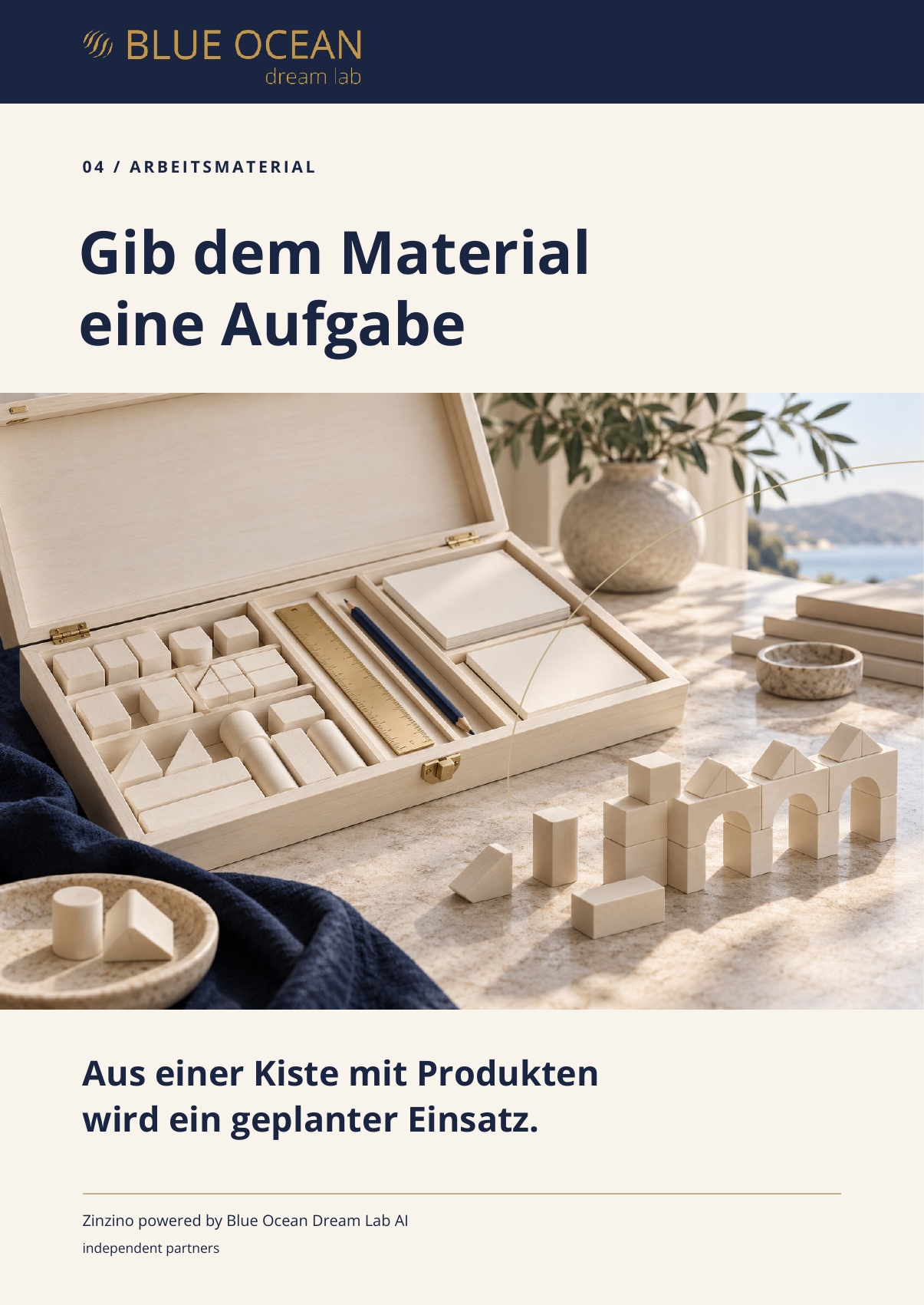
A box of products becomes a plan for using them.
Turn your materials into a working plan
What I am sharing here is the approach that has worked for me and many partners on my team. There are different ways to build this business. This is ours, drawn from experience and offered as a practical guide for your start.
When someone wants to begin after a business conversation, we show them a clear start: registration, orientation and their first tasks. Any voluntary order of materials is based on their planned first conversations and actual goals.
With the Ultimate package, one thought mattered especially to me: Look at the materials as someone who plans to use them. Which contacts do you want to prepare? What materials will you need? If you choose a package, give its use a clear direction from the beginning.
Plan that use specifically. Who do you want to talk to? After a suitable explanation, who could you offer a chance to try the products? How will you support those people afterwards?
A box of products becomes a plan for using your materials.
Know your resources and plan how to use them
Know what you are working with. What does your order cost? What is included? How will you divide it between personal use and products you intend to share for others to try?
Where available, the Ultimate Partner Kit Refund campaign offers a conditional reimbursement under its official terms. Before ordering, read the separate campaign sheet for your market, including the qualifying activity, deadlines, exclusions and payment process. Do not assume that repayment is automatic or due on a fixed date.
Share with a clear purpose
For the part you have deliberately set aside to share, my provocative shorthand is:
Do not use it all yourself. Share the products.
Let others try the products themselves. Give them the chance to form their own experience and their own view of Zinzino. Plan in advance what is for personal use and what is working material. Share the original products intended for that purpose, together with the right information.
You want to speak openly with friends. Begin with genuine interest in the person and an honest invitation. Listen to what is on their mind.
If you see a possible working partnership, bring it up. If they are interested in a product, show the right information. Find out what they want. That is the starting point for the next conversation.
The ten people who matter to you
Start with people who matter to you. The ten tests in the package gave me a manageable starting point for my first contact list.
I gave the first ten people who mattered to me a BalanceTest and an oil to try. I wanted to make starting easy: “The test is on me, and I will give you the oil to try as well. Would you like to know where you stand?” That was my approach at the time.
From the beginning, I also agreed on our next conversation. When the test result arrived, we would look at the report together. If the value was not yet in the green range, we would discuss what it meant and the possible next steps.
My invitation was specific: “If you would like to keep using the oil, we can register you as a customer and set up your subscription together.” My focus was a lasting customer relationship, with a regular supply, a clear point of contact and ongoing support.
If interest in the business came up, we talked about that too: “Would you like to see how we build this business?” Using products as a customer and building a business are two routes you can explain clearly. The person decides which one fits.
Keep the process simple. Spark interest. Offer the test and oil. Agree on a follow-up. Review the result when it arrives. If someone is ready earlier, take the customer or partner step together without waiting. That clear approach is something you can show a new partner too.
05 / FAST START
Get your start moving
Four steps. A clear start.
Would you like to know?
Our approach begins with a simple attitude:
I just want to know if you want to know. The test does the rest.
You go to people who matter to you and ask a simple question: “Would you like to know where you stand?” Show them the relevant video. If they are interested, explain the BalanceTest and offer the test and oil together, as I described in the previous chapter.
The test gives the conversation a concrete starting point. The oil gives them their own product experience. You support both and arrange the next contact straight away, instead of handing over materials and simply waiting.
That is the heart of my approach. Spark interest, show the right information and take the next step with the person. Keep it brief, clear and simple enough for a new partner to learn.
Support the product experience
Why did I give people with genuine interest the test and oil together? Because I wanted them to get to know the products while waiting for their report. Explain how to take the test and use the product with the information provided.
Think of a test drive at a car dealership. You offer it to someone who is seriously interested and could become a customer. You do not charge for that test drive. In the same way, share your working materials deliberately with people who genuinely want to explore the concept.
When the result arrives, review what the report actually shows. If the value is not yet in the green range, discuss the accompanying information and the questions it raises.
Ask for a promise, not a payment
My phrase is: “Ask for a promise, not a payment.” I provided the test and oil; in return, I asked for an agreed follow-up, not an obligation to buy or join. You could say: “The test and oil are on me. Let us talk again when your result arrives and discuss what you would like to do next.”
At the follow-up, ask: “Would you like to keep using the product as a customer? If so, we can set up your subscription together.” If they are also interested in building a business, show them that option.
This is a straightforward, low-pressure approach: let people try the product and get to know it. If someone is ready to buy straight away, make the sale, explain the terms and help them get started. There is no need to delay a decision they are ready to make.
Customer or partner?
People who want to use the products become customers. People who want to build a business choose the partnership. Customer registration is a valuable step towards a lasting relationship. Explain the commitment clearly and let the person choose.
You do not have to wait for the test result to register a customer or partner. Product experience, test analysis and business conversations can run in parallel. If someone understands the business potential and wants to join, help them start while their report is pending.
The interactive world map at zinzinotest.com illustrates the broader context: Zinzino reports that 97% of baseline tests were imbalanced. This describes the tested sample, not the whole global population, and does not predict an individual result. Use the map to explain the testing concept; review each person's own report when it arrives.
Customers order directly from Zinzino, linked to your partner ID. Help them understand the product, subscription and ordering schedule, and remain available for ongoing support.
Four donuts show the way
You do not need to master the entire compensation plan at the beginning. But you do need to understand Fast Start. The four donuts are your working plan. They show what you and your new partner need to work on next.
Focus on those four steps. Open the overview in the Back Office, look at where you stand and turn each unfinished target into a specific task. That gives your business-building work a clear direction.
In the training model, the four steps connect customer development with supporting partners:
1. Build a Q-Team within the first 30 days.
2. Enrol two partners within 60 days.
3. Help those two partners develop partners of their own within 90 days.
4. Reach X-Team within 120 days.
Check Zinzino's current official Fast Start documents for your market for the full requirements and deadlines, including active status, qualifying orders, Enrollment Points and placement. Registration alone does not complete a bonus target. Then work with the plan. Which requirement is still missing? Which conversation is next? Who can you help take their next step today?
The first step towards Q-Team
The first donut represents Q-Team. In the training, I used four customer points as the starting point. Begin by understanding customer development. Who wants to use the products regularly, and which orders count towards this goal?
Your own product use, and your family's where they choose it, belong in this picture too. A partner who stands behind the products should know them through personal use. Discuss the right ordering route with your sponsor and plan what you actually want to use in your household.
That lets you experience the customer side yourself: ordering, a regular supply and, where applicable, Zinzino4Free. Understand the requirements and show new customers the same clear process.
Help two partners get started
When someone says, “I want to join,” show them how to begin. In the training model, you start with two partners, one on each side. Clarify registration and placement, then work on the qualifying product sales needed for the next Fast Start step.
Then comes the key task. Help those two partners get started and show their first partners the same path. Prepare conversations together. Use the same materials. Demonstrate the same clear approach.
In the training example, those first two partners support four more. The picture is simple. In the Back Office, check which requirements have already been met for each stage.
You build your own business and help others build theirs. That is where duplication begins.
Develop customers on the way to X-Team
Fast Start connects partner development with customer development. On the route to X-Team described in the training, you add another six customers to the first four.
Keep both routes in mind: customers who want to use products and partners who want to build a business. Customer points and Enrollment Points reflect different kinds of progress. Understand what is missing and make that your next task.
Once you understand the connection, the plan becomes easier to work with. You can see whether the next step is a customer conversation, a partner conversation or support for someone who has already started.
Give your start some momentum
My principle is: this business is easier to build fast than slowly. I mean staying in action and avoiding unnecessary delays. The one hundred and twenty days give the training model its overall time frame. Within that plan, the official window for enrolling your first two partners is sixty days. Our working aim is more ambitious: a six-day loop.
Aim to help two partners get started in your first six days. Then help each of those two partners get their first two started in the next six days. That means two direct partners and four more across the next level: six people in twelve days. The second six-day period is their action step. Each new partner begins their own loop as soon as they start. They do not wait for you to finish yours. The loops can overlap. You are helping them repeat the same process.
Keep ambition high and pressure low. Six days is a working target, not a new qualification deadline or a promise of results. If it takes longer, keep working with your sponsor. Missing this personal target does not by itself cost you a company bonus. The current official requirements and deadlines still apply.
That is my ten-times idea. Cut unnecessary waiting time. Send the right video. Arrange the conversation. Help your new partner with their next contact straight away. Someday becomes an appointment in the calendar. Remove the air: eliminate unnecessary steps and waiting time.
To do that, you need to know what you are doing. Open your calendars, agree when you are available, and get to work. For me, working fast means preparing clearly and following through on the next step. Momentum starts with the next agreed step.
Understand the economics of your business too
Thinking like a business owner includes looking at your numbers. What are you spending? Which commissions have you actually received? Which activities produced those results? Keep clear records so you can make informed decisions about your business.
The Refund campaign and your commissions are two different things. A refund depends on the campaign targets; commissions follow the compensation plan. Understand both and show your new partner which specific tasks relate to each goal.
06 / DUPLICATION
Your example gets passed on
What you model is what others pass on.
Building something big starts at the base
For me, this business grows from the base up. When we help new partners start well and pass on the process, we create the foundation for a larger organisation.
That is why I focus on the beginning. Does the new partner understand the business? Can they use the right materials? Do they know what their Fast Start looks like? Are they having their first conversations? Are they getting support?
The foundation deserves your attention. A new partner who understands their next tasks has something concrete to work with. That is why I focus on the start, no matter how long I have been in the business myself.
Turn the red donuts green
Open the Fast Start overview in the Back Office with your new partner. Ask them to show you which donuts are still red. Then look together at what is needed for the next green donut.
Here is how I put it:
Our job is to turn the red donuts green.
Do they need help with a customer conversation? Is someone interested in the business but unsure how to begin? Are qualifying points, a placement or a follow-up appointment missing? Work on that next unfinished task.
Close the next gap. That is more useful than constantly talking about distant goals.
Who can we speak to together right now?
When a new partner wants to start, I ask: “Who could we call right now? Who else might be interested in what you have just heard from me?” Then prepare that contact together and show the person the business. Use your sponsor and the available event structure as well.
That makes getting started practical. Your partner hears a clear explanation, sees the materials being used and experiences a first conversation. They can begin to develop their own way of working from there.
That is where duplication happens. The new partner experiences the process and can repeat it later. They learn not only what you say, but how you go about it.
Your way of working gets passed on
As an upline, you influence the people who start with you. If you work in complicated ways, you pass on complexity. If you delay every step, that slowness can spread. If you speak clearly and provide reliable support, you show a different way of working.
That means we need to keep developing ourselves too. Our support should help a new partner improve. They should not have to inherit all our detours first.
For me, it is a matter of responsibility. We want talented, motivated people to have a clear start. For that, we need to know what we are showing them.
Documentation beats communication
Your new partner should experience how the business is built. They have conversations, support customers, understand their Fast Start steps and see their progress in the Back Office. That experience gives weight to their words.
My phrase for it is:
Documentation beats communication.
When your partner can explain what they have actually done and learned, they speak with a different kind of clarity. They are sharing their own experience. That is what I mean by “documentation beats communication”. A clear process and real progress make the explanation tangible.
Record your tasks and learning steps. What did you agree to do? What have you done? What is still missing? That makes the next task clear and helps your partner take responsibility, one step at a time.
That is where the confidence I mean comes from. You have tried something, understood it and can approach it more deliberately next time.
A new language takes practice
I do not expect you to put everything into practice perfectly after reading this once. If you decide to learn Italian today, you will not be fluent next week either.
It is the same with a new language for your business. You need to hear it, try it and improve it. You need feedback. And you need to be willing to leave out a familiar explanation when a simpler one works better.
That is why we have our training rhythm. Business Tuesday gives the business side its own space. Product Thursday focuses on products. Basic Saturday supports practical action and strengthens the fundamentals.
The consistency of those sessions matters. We do not need to reinvent the business every week. We can get better and better at the same essential steps.
Now get out on the court
Thinking like a business owner also means keeping track of income and expenses. What are you putting in? What results are coming from it? Where do you need a better process?
If the numbers are not yet working, examine the process closely. Which conversations are you having? How do you prepare them? What happens after someone shows interest? At what point does a new partner receive support?
Think back to my tennis coach. We practised on the court, received feedback and changed our movements. Step by step, what had felt unfamiliar became a new skill.
You can develop your way of working in the same way. Prepare an invitation. Use a good tool. Have the conversation. Afterwards, look at what you learned. Next time, you bring more experience to it.
You bring the willingness. Your sponsor supports your first steps. The materials give you a foundation, and the training helps you practise. Now you decide when to start.
Get out on the court. That is where your development begins.
Your next step
You have a path ahead. You can practise the conversations, use the tools and get support with your first steps.
Open your calendar. Agree on your next working session. Prepare a specific conversation.
EDITORIAL SOURCES AND REVIEW SCOPE
Sources accessed on 31 October 2026. The editions below are the copies actually reviewed, not a claim that all markets or subsequent updates have been checked.
[1] Zinzino Marketing Rules and Ethics Guidelines - 2025 Edition (English), 40 pages.
Reviewed: Ch. 1 (identity, IP and approval); Ch. 3 (sharing); Ch. 4, sections 1-4 and 6 (claims); Ch. 5, sections 3, 6, 7 and 9 (AI). The English AI policy states that German governs interpretation.
[2] Zinzino GmbH (Deutschland), Allgemeine Vertragspartnerbedingungen - 19 May 2025, version 5.0, 35 pages.
Reviewed: conduct rules; sections 2-3, 7-10, 14 and 26; annex references. German-market reference only; not a worldwide partner contract.
[3] Der Zinzino Verguetungsplan - 15 April 2026, 0007, German, 68 pages.
Publicly linked copy reviewed: p. 2 (earnings qualification), p. 10 (refund overview), pp. 20-21 (Fast Start). This does not establish that it is the latest plan for every market.
[4] Seldia, European Codes of Conduct for Direct Selling - eighth edition, amended 2024, 20 pages.
Reviewed: sections 1.8, 2 and 3 on national law, consumer information, fair selling, recruitment, earnings and inventory. Referenced in the German partner contract.
[5] Zinzino Express Start - English, publication identifier master-zinzino-expressstart-148x210-en-0002.
Zinzino Operations AB publication: traffic rules, Get Started training, contact list, 120-day goals and tools. Onboarding reference, not a substitute for contractual terms. Open source
[6] Zinzino Partner Rewards Program - Germany site, English-language page; no revision number displayed.
Reviewed: public 30/60/90/120-day outline and Zinzino4Free overview. Summary only; full plan conditions still apply. Open source
[7] Zinzino BalanceTest - English test portal and world statistics; no revision number displayed.
Reviewed: reported 97% baseline imbalance statistic, individual test scope and informational-use statement. Dataset statistic, not population prevalence. Open source
OPEN VERIFICATION POINTS
The applicable latest local contract and plan; the complete local refund campaign sheet; the German controlling AI-policy text; local product instructions, sales/subscription terms and privacy notices; any later Back Office updates; written approval for this handbook and its branding. No complete country-by-country legal review was performed.
The publisher confirms the ongoing 21st consecutive growth year on p. 11; independent documentary confirmation remains open.
USAGE NOTES AND PUBLICATION DETAILS
Dr. Sven Goebel | The Success Code | English team edition | Editorial review: 31 October 2026
Independent publication and review status
This team handbook presents the author's training approach as an independent Zinzino partner. It is not an official Zinzino publication, contract or compensation plan. No written Zinzino approval of this edition has been verified. Obtain the required permissions before external distribution, publication, adaptation or translation. The sources and remaining verification points are listed on the preceding page.
Business activity, results and costs
Business results vary. Income, profit, rank, growth and completion within a particular timeframe are not guaranteed. Building a business requires substantial work and involves costs and possible financial loss. Revenue, gross commissions and net profit are different measures. The 10X approach is an activity aim, not an earnings forecast or a change to official deadlines. Partner registration alone does not generate entitlement to compensation; qualifying sales and all applicable plan conditions govern.
Orders, qualification and refunds
Check the current official terms for your market before acting. The simplified Fast Start outline does not list every eligibility condition. Voluntary orders must reflect genuine intended use or realistic customer demand, not artificial qualification or excessive inventory. Family members decide independently. A free test or product trial does not oblige anyone to buy, subscribe or join. Explain the full price, recurring charges, duration, cancellation, withdrawal and return conditions before registration or an order. Any kit reimbursement is conditional on the separate applicable campaign rules and is not guaranteed.
Products, tests and personal decisions
This handbook provides no diagnosis or individual medical advice. Use current, locally approved product information and test instructions. Do not promise treatment, prevention, cure or a specific health outcome. Test reports describe the measured markers; they do not establish a medical diagnosis. Individual results vary. Anyone receiving medical treatment should discuss dietary changes with their treating professional. Share products only in the original form intended for that purpose, with the required instructions. The reported baseline-test statistic is not a measure of prevalence in the entire population.
Privacy, ownership and use of materials
Handle contact details, reports and testimonials only with the necessary permission and legal basis. Keep test IDs and reports private; do not request another person's login. Confidential company material and identifiable health data must not be entered into AI systems. Respect Zinzino's trademarks and third-party rights. Any share award depends on its own terms; share ownership involves risk and this handbook is not investment advice.
AI assistance
AI-assisted publication: text and design were edited with AI assistance; illustrative images are AI-generated. The author is responsible for reviewing and approving the final content.
Limits of the editorial review
This is an editorial source check, not legal certification or confirmation of worldwide compliance. It does not override mandatory law, the applicable partner contract or current official programme terms. A disclaimer cannot correct a misleading statement elsewhere in the handbook. Resolve the listed open points with Zinzino Compliance and, where needed, qualified local counsel before release.